GREECE
1 Courses
Golf in Greece: Ancient Landscapes Shaping a Mediterranean Golf Frontier
Golf in Greece has evolved from a niche pastime introduced in the twentieth century into a carefully curated tourism and sporting sector that reflects the country’s distinctive geography, cultural heritage, and environmental sensitivities.
The roots of the game in Greece trace back to the 1960s when the first modern facility, the historic Glyfada Golf Club of Athens, was established along the Athenian Riviera with design input from British architect Donald Harradine.
This early project reflected the influence of Western European tourism development during the postwar period, when Greece sought to diversify leisure offerings for international visitors arriving by air and cruise.
For several decades golf remained limited in scale due to terrain constraints, water scarcity concerns, and a national focus on beach tourism, but the early 2000s marked a turning point as integrated resort planning began to align golf development with luxury hospitality and sustainable land management.
Since the 2010s, especially after 2020, Greece has gradually positioned itself as a boutique Mediterranean golf destination, prioritizing high-quality resort courses rather than dense networks of clubs.
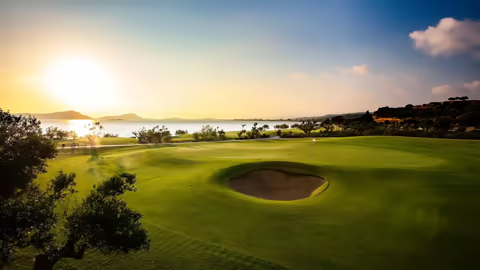
The Peloponnese peninsula has become the central pillar of Greek golf thanks to the Costa Navarino development in Messinia, where multiple championship courses have reshaped the country’s golf identity.
The Dunes Course, designed by Bernhard Langer in collaboration with European Golf Design, opened in 2010 and introduced strategic bunkering, generous fairways, and links-inspired movement through olive groves overlooking the Ionian Sea.
Nearby, The Bay Course by Robert Trent Jones Jr.
uses cliffside holes, seaside panoramas, and rolling Mediterranean terrain to create a visually dramatic but playable layout that has hosted international amateur and professional events, including tournaments on the European Challenge Tour in the early 2020s.
Additional courses within the same destination, such as the International Olympic Academy Golf Course and The Hills Course designed by José María Olazábal, opened in the 2020s and elevated Greece’s course inventory to modern championship standards while maintaining ecological sensitivity through drought-resistant grasses and water-efficient irrigation systems.
Beyond the Peloponnese, the Athens Riviera remains historically significant, with Glyfada Golf Club continuing to operate as the country’s oldest course and a training ground for many Greek golfers.
In northern Greece, regions around Halkidiki and Thessaloniki have explored smaller resort-oriented facilities that complement coastal tourism, while Crete has periodically studied golf development tied to luxury resorts, reflecting the island’s capacity to attract international visitors throughout the Mediterranean travel season.
Player development in Greece is still emerging but has gained structure through the Hellenic Golf Federation, which coordinates junior academies, youth tournaments, and coaching certification programs.
Facilities at Costa Navarino and Glyfada now host junior training camps and international amateur competitions, helping expose Greek players to competitive pathways across Europe.
While Greece has not yet produced globally prominent professional golfers, a new generation of amateurs has increasingly participated in European amateur championships since the early 2020s, benefiting from improved training infrastructure and international coaching partnerships.
Tourism remains the driving force behind the country’s golf strategy, with most courses embedded within luxury resorts that integrate golf with cultural exploration.
Visitors often combine rounds with archaeological tourism in sites such as ancient Olympia or Mycenae, seaside sailing in the Ionian and Aegean Seas, and culinary experiences centered on olive oil, seafood, and regional wines.
Peak golf travel seasons occur during spring and autumn, when temperatures remain moderate and landscapes are lush following winter rainfall, making conditions ideal for walking courses overlooking Mediterranean coastlines.
Sustainability has become a central principle in Greek golf planning, particularly because water availability and ecosystem preservation are sensitive issues in many coastal regions.
Resorts such as Costa Navarino have invested in desalination plants, recycled water irrigation networks, solar energy installations, and habitat protection programs that preserve native flora and birdlife within course boundaries.
Environmental certifications and biodiversity monitoring programs have become increasingly common since 2020 as developers seek to demonstrate responsible land stewardship while attracting environmentally conscious travelers.
Looking ahead, Greece’s golf expansion strategy focuses on measured growth rather than rapid proliferation.
Tourism authorities have periodically discussed potential new resort courses on islands such as Crete or Rhodes, and there have been exploratory conversations about attracting larger European tour events if infrastructure continues to improve.
Industry forecasts suggest that the country will remain a specialized Mediterranean golf destination characterized by a small number of high-quality courses integrated with luxury resorts and cultural tourism, appealing particularly to travelers seeking golf experiences framed by ancient landscapes, coastal panoramas, and the enduring heritage of Greek civilization..