
EGYPT
5 Courses


Golf in Egypt: Desert Fairways Between the Nile, the Red Sea, and a Century of Cosmopolitan Influence
Golf in Egypt reflects a layered sporting history shaped by colonial-era introductions, post-independence modernization, and a contemporary resort-driven expansion rooted in desert geography and year-round playability.
The sport first appeared in Egypt at the end of the nineteenth century, introduced by British expatriates and administrators during a period when Cairo and Alexandria functioned as cosmopolitan hubs of the eastern Mediterranean.
Early courses were closely associated with social clubs serving foreign communities, with Gezira Sporting Club in Cairo often cited as one of the earliest structured environments where golf took hold, initially as a leisure activity rather than a competitive sport.
Through the early twentieth century, golf remained limited in scale and largely disconnected from the wider population, but it established a foundation of course management knowledge and etiquette that persisted after independence.
From the 1970s onward, Egypt’s economic opening and the growth of international tourism gradually repositioned golf as a tool for destination branding, a trend that accelerated sharply in the 1990s and 2000s with the rise of gated residential developments and Red Sea resorts.
Post-2020, golf in Egypt has increasingly emphasized sustainability, international tournament visibility, and integration with luxury travel rather than sheer numerical expansion.
Regional diversity defines the Egyptian golf experience, with several distinct zones shaping course character.
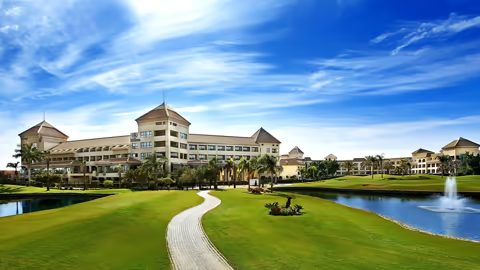
Greater Cairo remains the historic and administrative heart, where courses are embedded within urban or peri-urban developments and emphasize parkland-style layouts with mature trees, lakes, and strategic bunkering, serving both resident golfers and expatriate communities.
The Alexandria and North Coast region offers a Mediterranean-influenced alternative, with milder summer temperatures, coastal breezes, and seasonal play patterns aligned with domestic tourism.
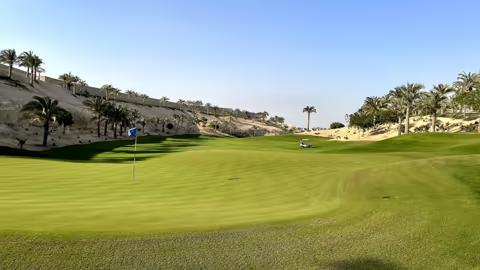
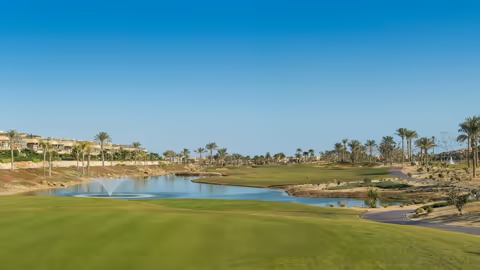
The Red Sea corridor, particularly around Hurghada, El Gouna, and Soma Bay, represents Egypt’s most internationally visible golf region, defined by arid desert landscapes, minimal rainfall, and courses routed through sand and salt-tolerant vegetation, often framed by mountain backdrops and sea views.
Emerging inland destinations near the New Administrative Capital point to a future axis of golf tied to real estate development and infrastructure investment.
Signature courses illustrate how architecture has adapted to these environments.
The Katameya Dunes Golf Course, designed by Nick Faldo, exemplifies modern desert golf near Cairo, using waste areas, strategic angles, and firm playing surfaces to create challenge without excessive water use, and hosting professional and high-level amateur events in recent years.
Palm Hills Golf Club, designed by Sanford Golf Design, reflects a more traditional parkland aesthetic adapted to desert conditions, with water hazards and rolling fairways supporting member play and national competitions.
On the Red Sea, El Gouna Golf Club, originally designed by Gene Bates and later refined, stands out for its integration of lagoons and desert vistas and its history of hosting European Tour events, including tournaments that continued into the early 2020s, reinforcing Egypt’s place on the international calendar.
Soma Bay Golf, designed by Gary Player, uses elevation changes and open horizons to emphasize wind as a strategic factor, while Madinaty Golf Club near Cairo focuses on accessibility and large-scale residential integration rather than tournament hosting.
Player development in Egypt remains a work in progress, but post-2020 initiatives by the Egyptian Golf Federation have strengthened junior programs, coaching certification, and partnerships with international academies.
While Egypt has yet to produce a sustained presence on major global tours, several players have competed on regional and developmental circuits, and women’s participation has grown through school-based programs and targeted scholarships.
Golf tourism is one of Egypt’s strongest assets, benefiting from a winter peak season between October and April when temperatures are moderate and European demand is high.
Travel packages typically combine unlimited golf with five-star accommodation, spa access, and proximity to cultural landmarks, allowing visitors to pair rounds with excursions to the pyramids, Nile cruises, or Red Sea diving.
Cultural interaction plays a role in shaping the golf experience, as dress codes tend to balance international golfing standards with local norms, encouraging modest attire off the course and respectful behavior in shared spaces, particularly during religious periods such as Ramadan.
Sustainability has become central to Egyptian golf operations since 2020, driven by water scarcity and energy costs.
Courses increasingly rely on treated wastewater for irrigation, drought-resistant grasses, solar-powered facilities, and habitat management plans that protect desert flora and migratory bird routes, while environmental certifications are used to demonstrate compliance with international expectations.
Looking forward, Egypt’s golf sector is expected to pursue selective growth through new resort-linked courses, upgrades to existing facilities, and bids for additional international tournaments, positioning golf as a strategic component of diversified tourism rather than a mass-participation sport, with forecasts emphasizing resilience, efficiency, and cultural sensitivity..