CYPRUS
2 Courses
Golf in Cyprus: Mediterranean Desert Fairways at the Crossroads of Europe and the Levant
Golf in Cyprus occupies a distinctive niche shaped by the island’s layered history, semi-arid climate, and position at the cultural crossroads of Europe and the Middle East.
Although the British introduced elements of organized sport during the colonial period in the late nineteenth and early twentieth centuries, Cyprus did not develop formal golf infrastructure until much later, largely because water scarcity and agricultural priorities limited large-scale turf projects.
The first modern 18-hole course, Tsada Golf Club, opened in 1994 in the hills above Paphos, marking the true starting point of Cypriot golf.
Its creation coincided with the Republic’s broader tourism diversification strategy following economic restructuring in the 1980s.
A second milestone came in 2002 with the opening of Secret Valley Golf Club near Petra tou Romiou, integrating golf into coastal resort development.
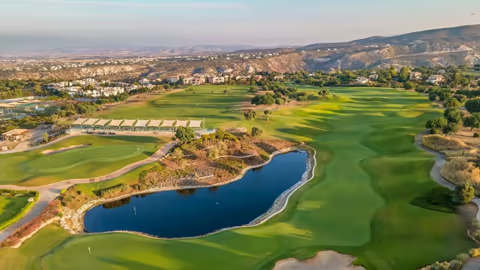
The most transformative project arrived in 2008 with Aphrodite Hills, part of a master-planned community combining real estate, hospitality, and sport, signaling Cyprus’s ambition to compete in the Mediterranean winter-sun golf market.
Since 2020, national golf participation has remained modest in absolute numbers—estimated in the low thousands—but steady, supported by the Cyprus Golf Federation’s structured handicap system and affiliation with the European Golf Association.
Regionally, golf activity concentrates in three primary zones.
The Paphos district on the southwest coast is the epicenter, benefiting from relatively higher rainfall and cooler elevations that allow year-round play; its courses blend mountain backdrops with sea views and rely on drought-resistant turf species.
The Limassol corridor, although better known for commercial shipping and finance, supports nearby resort golf linked to luxury residential developments.
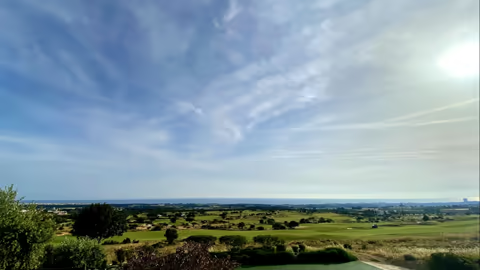
Inland foothill areas between Paphos and Polis offer elevation-driven layouts with panoramic vistas and wind exposure that influence shot strategy.
Signature courses reflect this environmental diversity.
Aphrodite Hills Golf Course, designed by Cabell B.
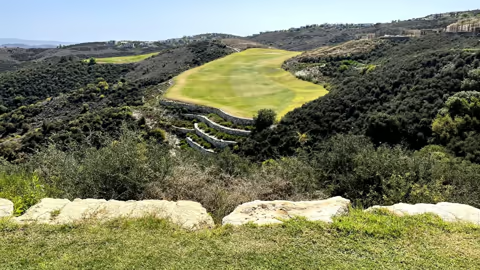
Robinson, stretches to over 6,200 meters from the championship tees and is built around dramatic ravines and a canyon-like carry on the par-3 7th hole; it has hosted European Tour Qualifying School stages and international amateur championships, reinforcing its competitive credentials.
Elea Golf Club, opened in 2010 and designed by Sir Nick Faldo, emphasizes strategic bunkering and desert-style waste areas, integrating olive and carob trees into a layout measuring approximately 6,300 meters; its design philosophy encourages risk-reward decisions rather than penal rough, aligning with modern sustainability constraints.
Secret Valley, originally conceived by Iacovos Iacovou and later redesigned, threads through limestone valleys shaped by coastal winds, while Minthis, redesigned by Mackenzie & Ebert and reopened in 2021, occupies a former monastery estate at 550 meters above sea level, using bentgrass greens adapted to altitude and offering a routing that balances vineyard scenery with strategic doglegs.
Player development remains an evolving dimension.
The Cyprus Golf Federation oversees junior circuits and collaborates with international coaching academies based primarily in the Paphos region.
Post-2020 initiatives have emphasized grassroots clinics in partnership with private schools and resort academies, aiming to counterbalance the sport’s perception as expatriate-oriented.
While Cyprus has yet to produce a regular DP World Tour contender, several amateur players have represented the nation in the European Team Shield Championships, and diaspora athletes with Cypriot heritage have competed in collegiate golf in the United Kingdom and United States.
Tourism remains the primary driver of demand.
Peak golf season runs from October through April, when daytime temperatures average between 17 and 24 degrees Celsius, positioning Cyprus as an alternative to Spain’s Costa del Sol or Portugal’s Algarve for winter training camps.
Integrated packages combine unlimited golf with spa access and beachfront accommodation, and proximity to archaeological landmarks such as the Tombs of the Kings or the sanctuary of Aphrodite provides cultural depth beyond the fairways.
Social customs reflect Cyprus’s predominantly Orthodox Christian heritage and Mediterranean lifestyle; dress codes align with European norms, and clubhouse culture often blends British traditions with local cuisine, including meze-style dining after rounds.
Sustainability has become central due to chronic water stress.
Since 2020, courses have expanded the use of treated wastewater for irrigation, installed moisture-sensor systems, and reduced turf acreage in out-of-play zones.
Native landscaping with carob, olive, and pine species supports biodiversity, and several facilities participate in environmental monitoring aligned with European Union water directives, though formal GEO certification remains limited.
Energy efficiency measures, including solar panels on maintenance facilities, have also expanded.
Looking forward, discussions continue regarding additional resort-linked courses, particularly in the Polis and Larnaca regions, though permitting remains sensitive to environmental impact assessments.
The Cyprus Golf Federation has explored hosting Challenge Tour events to elevate visibility, and tourism authorities forecast gradual growth tied to high-spending niche travelers rather than mass participation.
In this way, golf in Cyprus reflects the island itself: compact yet strategically positioned, shaped by climate constraints, colonial echoes, and a contemporary push toward sustainable Mediterranean luxury..